Show Works Off Grid Solar Project
Over the recent years I’ve become increasingly interested in energy independence and solar power. Part of it is curiosity and learning, but also wanting to understand what goes into serious power infrastructure.
Through this, I knew I wanted a new project with some serious engineering.
What started as a small idea quickly turned into an building a small containerised adaptable micro grid.
The Specs
- 80kWh Of Battery Storage
- 45kVA Continuous Output
- 90kVA Peak Output
- 3 Phase
- Remote Monitoring
- 400A Powerlock In/Out
- ATS Function
- Variable ELR
- Containerised Design
Solar Generation
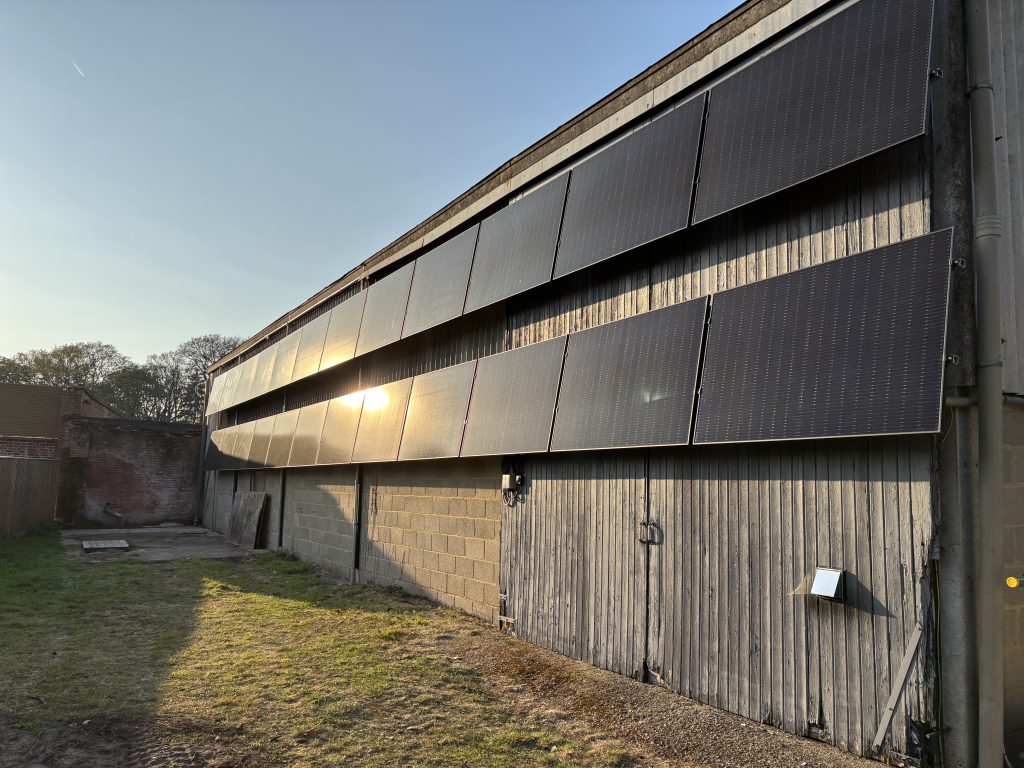
Show Works HQ is fitted with what I like to describe as “just a couple of solar panels…”
- 24 x 400w Panels (Warehouse Rear)
- 5 x 440w Panels (Office)
- 4 x 440w Panels (Containers)
- 4 x 440w Panels (Toilets)
Total: 37
This gives a total generation capacity of roughly:
≈ 15 kW peak solar generation
The panels are split across multiple arrays, which allows flexibility in how the power is collected and managed.
Design
At the heart of the system is 9 x Iconica 5kW rack mount inverters, capable of producing 45kVA of continuous output (15kVA per phase), as well as 90kVA surge output for 5 seconds.
These inverters also manage the battery charging and solar input, each capable of handling 4000w of solar per inverter, for a total of 36000w.
Inverters are linked together via RS232, allowing communication between the inverters of loads, battery status and other settings.
Mains power is split and merged between the inverters via a custom power distro built by SES. This distro provides grid electricity to all of the inverters, allowing the inverters to charge the battery bank when there is no sun. Inverters are linked back together in sets of three (eg. three inverters per phase), to provide the full 15kVA per phase supply.


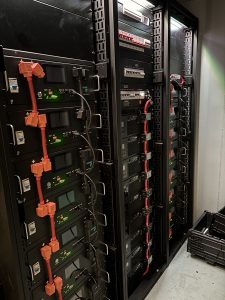
Battery storage is provided by 16 Fogstar 5.12kWh rack batteries, making up for a whopping 723.2kg of the weight in the container.
Both the inverters and batteries communicate with each other to maintain effective operations. Battery SoC (state of charge), as well as temperature, voltage and power draw is shared so the inverters can manage loads suitably and protect the batteries in the process.
The battery bank needs to be able to handle massive loads totalling up to 45 kVA – whilst at 230v, 45kVA works out to an amperage of 196A, the amperage at the lower voltage of the batteries (48v) means that the DC amperage totals 938A at the peak inverter output.